Content Marketing Was Broken. AI Fixed It. Now We Have New Problems
Remember the old days of content marketing? It often felt like a frustrating game of 'telephone.' A brilliant idea from the top would get whispered down the line, losing its spark and meaning by the time it reached the person actually creating the content. Quality could slip, teams worked in silos, and getting anything truly aligned felt like a miracle. It was a bit broken. But then, something revolutionary happened.
This article explores how Generative AI (GenAI) and Large Language Models (LLMs) are fixing the deep-seated flaws of the old content lifecycle, while simultaneously introducing significant new technical, economic, and ethical challenges that every leader must now confront.
Our Core Idea:
While GenAI and LLMs are undeniably addressing many of the systemic flaws in the traditional content marketing lifecycle, they are also introducing significant new technical, economic, and ethical challenges. Success in this AI-native era demands a proactive approach to understanding these shifts, developing a hybrid skill set, and championing human-centric values like empathy and critical oversight.
The 'Broken' Past: Why the Old Way Was Just Inefficient
Content marketing, before GenAI, faced some big, frustrating problems. These weren't just minor hiccups; they were deep, systemic flaws that often stopped great ideas from ever reaching their full potential.
The Whisper Down the Lane: Losing Ideas Along the Way
Have you ever played 'telephone' where a message gets whispered from person to person, and by the end, it's completely different? That's what content marketing often felt like. A Chief Marketing Officer (CMO) might have a brilliant strategic vision for a new campaign, full of nuance and specific goals. However, as that vision gets passed from the marketing lead to content managers and on to freelance creators, crucial details often get lost. This friction often led to content that either missed the brand's core message or felt completely off-brand.
It felt like a village council meeting. The Chief has a clear vision for a new, massive market square – accessible and designed to serve everyone. He informs the elders, who then tell the community heads, who finally contract the builders. By the time the builders start work, the message has changed: 'just build a decent square, in some place convenient.' The final market square is small and hidden, serving only a few people. The Chief's original, important vision was utterly lost in those many hand-offs!
The Wild West of Quality: No Rules, No Referees
Before integrated systems, it was challenging to enforce best practices or verify content quality. Think of it like a cooking competition where every chef used their own ingredients and methods, and there was no judge to ensure consistency or safety standards. A junior writer might use a poor external AI tool with weak instructions, generate unoriginal and low-quality content, and then falsely claim they wrote it all themselves. Managers had no easy way to ensure consistency, quality, or verify the content's true origin. This resulted in an inconsistent brand voice and content that fell short of expectations.
Data Overload, Insight Drought: Speaking Different Languages
Legacy SEO and analytics tools often presented overwhelming dashboards filled with raw data. Imagine having a treasure map written in a secret code that only one person on your team understands – everyone else is left guessing, and finding the treasure takes forever! This is what happened with complex data. It wasn't meaningful to non-specialist team members, such as writers or designers. This created huge bottlenecks, slowing down projects and preventing teams from making quick, data-informed decisions together. It was hard to be agile when only a few people could 'speak' the data's language.
SEO's Great Transformation: From Traditional to AI-Powered (GEO if I May)
Then came AI, and everything started to shift. The world of content marketing and SEO is no longer just about ranking for keywords. It's evolving into something far more sophisticated.
Meet GEO: Your New Best Friend in Search
Conventional SEO was like putting up a great sign for your shop, hoping people would see it and walk in. Now, with Google's AI Overviews (AIO) and the likes, you have a super-smart personal assistant that tells people exactly where to find your shop and why it's the best, even if they don't click your sign! This new world has many non-standardised monikers, but we'll call it Generative Engine Optimisation (GEO) for now. It means we're focusing on making our content so clear, factual, and well-structured that AI-powered search tools will directly understand and cite it as the definitive answer.
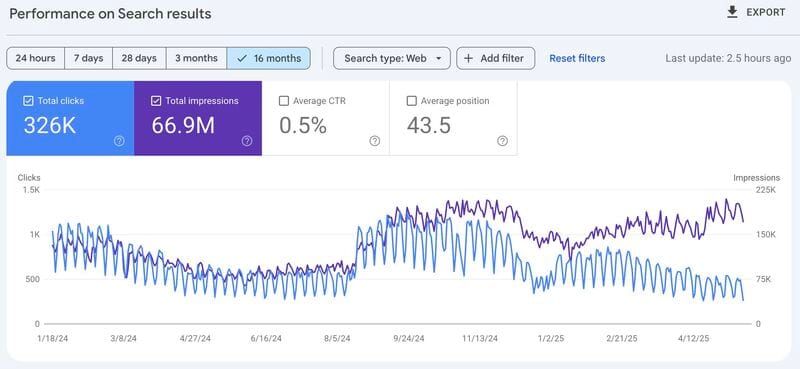
AI Overviews are changing the game. They often provide immediate, comprehensive answers right at the top of the search results, which means fewer direct clicks on the traditional 'blue links' to your website and the 'crocodile-mouth graph' screenshot above. But here's the crucial part: If your content is chosen and cited by the AI, you still get huge brand visibility and establish yourself as an authority. The goal has evolved beyond mere clicks; it's now about citations and recognition as a trusted source. How is that for return on investment? I guess we'll soon find out.
The New Tech Skills You'll Need: Becoming an AI Whisperer
This new landscape demands new skills. Think of it like learning to drive a new, advanced sports car with many more controls and features than your old family sedan – you need new skills to master it safely and effectively. You also need to know when to drive it fast for brand awareness (like with informational content often cited by AI) versus when to drive it directly to the customer's doorstep for a sale (like with commercial content).
To become an "AI Whisperer" or a GEO expert, you'll need a mix of traditional SEO-smart skills and new AI-specific talents:
- Advanced Prompt Engineering: This is like learning how to 'talk' to AI effectively, giving it precise instructions so it generates content that's on-brand, accurate, and perfectly optimised.
- AI-First Content Structuring: You'll need to organise your content so AI can easily understand and cite it. Ensure your headings are accessible and pages load fast. Properly structuring page content makes your information easy for AI to extract.
- E-E-A-T (Experience, Expertise, Authoritativeness, and Trustworthiness). Build topical authority. Conduct thorough research, provide unique insights, and maintain clear authorship.
- Schema Markup: This is like adding special tags to your content that explicitly tell search engines and AI what your content is about (e.g., "this is an FAQ," "this is a how-to guide"). It significantly increases the chances of your content being understood and cited.
- Understanding New Intents: Users are asking questions in more complex, conversational ways, sometimes even asking for multi-step plans. You'll need to optimise your content to answer these more profound questions and cater to these new AI-driven search behaviours.
- Strategic Intent Balancing: For informational questions (like "how-to guides"), the goal shifts to being cited by AI Overviews for brand awareness. However, for commercial or transactional queries (such as "best laptops" or "buy shoes"), direct clicks continue to drive sales. You'll need to know when to focus on each type of content to maximise impact.
Zero Click Searches
Studies show a significant decline in organic clicks (averaging over 24% and, in worst cases, up to 45.12%) when an AI Overview is present. Users often find their answers directly within the AI-generated summary, reducing the need to click through to external websites.
The Price of Progress: New Hurdles in the AI Era
While AI fixes old problems, it also brings new challenges. It's not a magic wand; it's a powerful tool with its own set of complexities.
The AI Tool Tag: Is Great Content Only for the Rich?
Procuring secure, integrated, and robust AI platforms (like custom AI agents or private LLMs) can be costly. Imagine a fantastic new professional sports league, but only teams with huge budgets can afford the best gear and training facilities, making it impossible for smaller, talented teams to compete. This high cost creates an economic barrier, potentially pushing advanced SEO and content strategy to become an enterprise-level business where large agencies are favoured. This trend risks pricing out smaller teams and individual practitioners who may have brilliant ideas but lack access to these prohibitively expensive tools.
Who Gets Ahead? The "AI Native" Advantage
The demand for highly technical, AI-specific skills grants a biased advantage to those who quickly acquire this new expertise. Imagine a competitive cooking show where some chefs suddenly get access to advanced, automated kitchen robots that can perfectly chop, mix, and even suggest recipes in real-time. In contrast, others rely solely on their traditional knives and culinary experience. Both are talented, but one group has a powerful, time-saving tool that dramatically amplifies their speed and precision. The huge GenAI and LLMOp learning curve risks marginalising traditional content specialists who excel in human-centric creation but lack AI-native skills. The barrier to entry into content marketing can become significantly steeper, making it harder for talented individuals to break in or keep up without re-skilling.
Keeping Content Human: The Empathy Advantage
In this rush for efficiency and personalisation at scale, there's a critical element we must never lose: the human touch.
The Empathy Deficit: Why AI Needs Your Heart
While AI is incredibly efficient, it fundamentally struggles with nuanced emotional intelligence, cultural context, and forging authentic human connections. AI can perfectly paint by numbers, creating a technically flawless picture, but only a human artist can create a masterpiece that truly moves your soul. Over-reliance on AI may advance content that, although technically correct, feels sterile, culturally misaligned, or lacks a genuine brand voice. It might sound smart, but it won't connect with people's hearts.
Your Superpower: Human-in-the-Loop & Ethical AI
Implementing new policies is crucial to addressing the empathy deficit and ensuring content quality. Think of it this way: AI is a super-fast, powerful car, but you are the skilled driver with the map, the moral compass, and the understanding of where people genuinely want to go and how they want to feel when they get there. You're also the mechanic, making sure the car doesn't break down or cause accidents! This means:
- Mandatory Human Oversight: We need policies that require human review and refinement at critical stages of the AI-powered content workflow (from ideation to final editing). This injects empathy, ensures cultural relevance, and prevents penalties for low-quality or manipulative AI-generated content.
- Ethical AI Guidelines: Establish clear internal guidelines for responsible AI use, addressing bias, transparency, accuracy, and data privacy. Using secure, private AI models for sensitive company data is essential.
- Focus on Data Privacy: Always exercise caution when inputting information into public AI models to protect sensitive company and customer data.
The New Skill Set: Becoming a Human Amplifier
This isn't about humans vs. AI; it's about humans amplified by AI. Your superpower is your uniquely human ability to think critically, understand culture, connect with audiences emotionally, and tell compelling stories. Cultivate skills like critical thinking, ethical AI use, cultural intelligence, audience psychology, and creative storytelling to 'humanise' AI output and maintain an authentic brand voice. The focus shifts to strategic integration, not replacement. You become the conductor of an AI orchestra, ensuring every note is perfect and the symphony captivates the audience.
Conclusion & Call-to-Action
Overall Verdict: More Than Just Inefficient – It Was Fundamentally Broken!
Our detailed exploration revealed that the traditional content marketing system was indeed 'fundamentally broken' due to systemic flaws like lost context, accountability gaps, and data interpretation barriers. GenAI and LLMs are not just making things faster; they are profoundly re-architecting the industry, solving many old problems while simultaneously creating significant new technical, economic, and ethical challenges.
The Future is Hybrid: Your Indispensable Role in the AI Revolution
The future of content marketing is about strategically combining AI's immense power with uniquely human creativity, empathy, and ethical oversight. It's about harnessing AI to automate the mundane, allowing humans to focus on the magical – connecting with audiences on a deeper level.
Your Mandate: Become a Human Amplifier!
This is your moment to thrive! Don't be left behind. Explore new skills, engage in AI discussions, and become a leader in human-amplified content creation.



Comments
Sign in to join the conversation
Sign In