The AI Griot: Reimagining African Heritage for a Digital Future
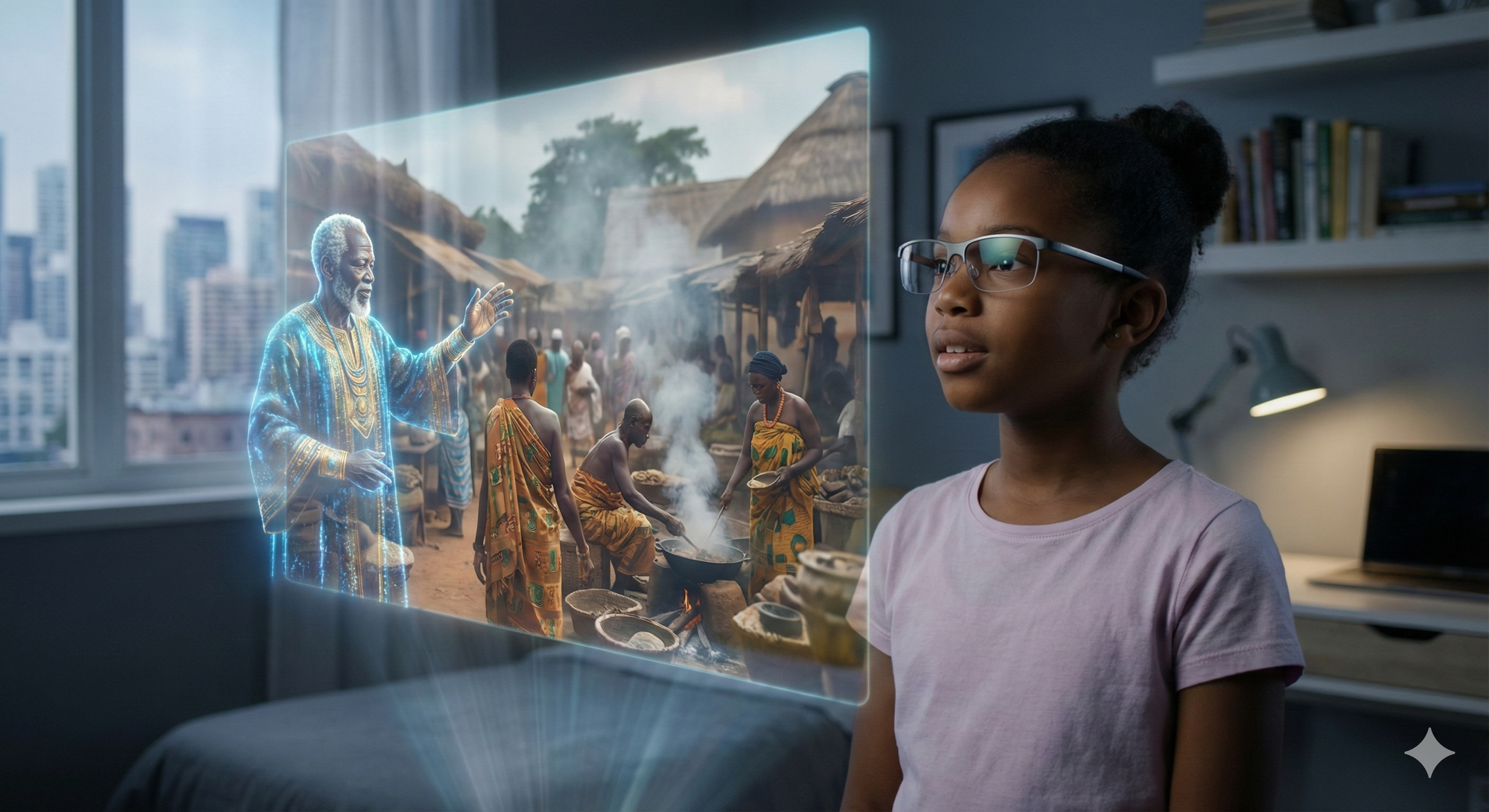
What if a young girl in Toronto, whose great-grandparents are from the Ashanti Kingdom, can re-imagine her ancestral heritage with a lightweight pair of glasses? Suddenly, she isn’t in her bedroom anymore. She is standing in the bustling heart of Kumasi in the 18th century. The air is thick with the smell of cooking fires and the sound of the marketplace. Beside her stands a wise, calm figure (a digital storyteller). This is the AI Griot. It knows her family lineage and begins to tell her not just the history of her people, but her story, woven into the grand tapestry of the past. This isn't science fiction. It isn’t the future - it is the tangible now, one that answers a profound need: How do we make our heritage a living, breathing part of our lives instead of a distant echo locked in books?
This article explores a powerful blueprint for re-imagining African heritage. We will define the ‘Agentic AI Griot,’ a personalized AI guide to history and culture. We will ground this vision in the philosophy of Afrofuturism, which provides the 'why' behind the 'what'. Crucially, we will look at the real-world proof in Rwanda, a nation already building this knowledge-based future and demonstrating its economic power. Finally, we will explore the immense potential for sociopolitical liberation this technology offers, while also acknowledging the diverse challenges and developmental paths across the continent, as seen in regions like the Sahel. This is the story of how Africa can use the tools of tomorrow to reclaim and monetize the treasures of yesterday.
What is Afrofuturism's Role in Africa's Digital Future?
When many people hear 'Afrofuturism,' their minds jump to the gleaming spires of Wakanda in Black Panther. While a stunning example, it only scratches the surface. At its core, Afrofuturism is a philosophy and a cultural movement about reclaiming the narrative of the future.
As defined by foundational thinkers like Ytasha L. Womack in her book Afrofuturism, it’s the intersection of African and diasporic culture with technology, imagination, and self-determination. It asks a powerful question: What does the future look like when it’s designed by us, for us, on our own terms?
Think of it like this: Your grandmother’s treasured book of family recipes. The traditional approach to bequeathing the family legacy is to lock the book in a safe. The recipes are safe, but no one gets to taste them.
The Afrofuturist takes those recipes, understand the spirit and flavor of each one, and then use the most advanced kitchen technology - a sous-vide, a thermal circulator - to create new, incredible dishes. You haven’t replaced the old; you’ve given it a new, vibrant life.
This is exactly the role Afrofuturism plays in Africa's digital future. It provides the framework to look at ancient traditions, deep-rooted cultures, and rich histories not as relics to be preserved behind glass, but as the core ingredients for building new technologies, new economies, and new ways of seeing the world. It’s the philosophical engine driving the very idea of the AI Griot.
What is the "Agentic AI Griot" and How Does It Work?
To understand the AI Griot, we must first honor its namesake. In many West African traditions, a Griot is far more than a storyteller. They are the living libraries of a people (historians, musicians, genealogists, and advisors) who carry centuries of oral tradition.
The 'Agentic AI Griot' aims to translate this sacred role into the digital age.
Ashanti Heritage re-Imagined with Veo3
Beyond a Chatbot: The 'Agentic' Difference
This isn't just a smarter version of Siri or a chatbot you ask straightforward questions. The catchphrase is 'Agentic AI'.
A standard AI is like a calculator. You ask it, "What is 2+2?" and it gives you "4." An Agentic AI is like a personal financial advisor. You tell it, "My goal is to retire at age 35," and it gets to work. It analyzes your spending, researches investment options, and proactively makes adjustments to help you reach your goal, sometimes without you even having to ask.
The AI Griot is that proactive advisor for your cultural identity. Trained on a vast and verified dataset of historical texts, archaeological findings, oral histories, and artistic traditions, it can:
- Personalize the Journey: It can tailor historical narratives to a user's specific ancestry or interests.
- Provide Immersive Context: Paired with VR/AR, it acts as a guide inside digital reconstructions of ancient cities like Great Zimbabwe or the Benin Kingdom.
- Answer Deep, Nuanced Questions: It can explain not just what happened, but the cultural 'why' behind events, traditions, and beliefs.
The Ethical Mandate: Avoiding Digital Caricature
Creating such an AI is a monumental task fraught with ethical risks. A poorly designed AI Griot could become a form of digital blackface - a shallow caricature that flattens diverse cultures into stereotypes. As the MIT Technology Review highlights in its reporting on AI and cultural diversity, the fight to make AI culturally aware is one of the most critical challenges of our time.
Building a true AI Griot requires a radical collaboration between AI engineers, historians, linguists, elders, and artists from the continent to ensure the data is authentic, the context is respected, and the soul of the story is preserved.
Is This Vision Happening in Africa Today? The Case of Rwanda
This grand vision of a technologically sovereign Africa might sound like a distant dream, but it’s already taking root. For proof, we need only look to Rwanda.
Rwanda’s story is a real-world testament to the Afrofuturist spirit - a nation that has become a phoenix rising from the ashes of its tragic history to deliberately build a future based on knowledge and innovation. This isn’t happening by accident; it is the result of a clear, top-down strategy.
- The National Vision: The government’s Vision 2050 plan explicitly names ICT and innovation as central pillars for transforming Rwanda into a high-income, knowledge-based economy.
- The Epicenter of Innovation: The flagship project is the Kigali Innovation City (KIC), a master-planned hub designed to attract global universities, tech companies, and venture capital. The goal is audacious: To nurture billion-dollar 'unicorn' startups on Rwandan soil.

- The Proof is in the Funding: The strategy is working. As the World Economic Forum reports, Rwanda is succeeding in tackling development challenges. Investor confidence is soaring. The most telling statistic is the explosive leap in startup funding, which jumped from a modest $4 million to an incredible $45 million in 2023 alone.
Rwanda is creating the very ecosystem which the developers, AI specialists, and digital artists needed to build the AI Griot that will thrive. It serves as a powerful, concrete example that the fusion of technology and national vision is not just possible, but is already a potent force for transformation.
How Does This Create Economic and Sociopolitical Liberation?
The concept of the AI Griot and the digital reconstruction of heritage goes far beyond cultural preservation. It is a direct pathway to economic empowerment and liberation.
For centuries, African artifacts have been physically extracted and displayed in foreign museums, with the economic benefit flowing elsewhere. In the digital age, the risk is 'digital extraction' - where data and stories are taken and monetized by outside firms.
The AI Griot model flips this dynamic on its head.
From Cost Center to Value Creator
Traditionally, heritage preservation is a cost. It costs money to maintain museums, protect archaeological sites, and store archives. The AI Griot model transforms heritage into a high-value asset that can generate revenue.
Imagine selling subscriptions for immersive historical experiences, licensing digital assets of reconstructed artifacts for films and games, or creating educational platforms for schools and universities worldwide. This creates a self-sustaining cycle where revenue from digital heritage can be used to fund further preservation and research on the ground.
This model creates a new generation of high-value jobs on the continent: AI Ethicists, 3D Artists specializing in historical accuracy, Digital Linguists, and VR Experience Designers. It fosters a high-value, globally competitive industry based not on extracting raw materials from the earth, but on cultivating the rich intellectual and cultural capital that is uniquely Africa’s.
What Are the Challenges and Alternative Paths?
While the vision of the AI Griot is powerful, it's crucial to understand that Africa is a continent of 54 diverse nations, each with its own unique set of priorities and challenges. The path for Rwanda is not the path for everyone.
The Sovereignty-First Path: The Alliance of the Sahel States (AES)
A compelling counterpoint is the Alliance of the Sahel States (AES), comprised of Burkina Faso, Mali, and Niger. These nations, facing immense security challenges and political upheaval, are on a different journey. Their 'real advancements' are not currently in AI, but in foundational sovereignty.
Their focus is on building the very bedrock of a self-sufficient confederation:
- Security: Their alliance is, first and foremost, a defense pact.
- Finance: They have established their own investment bank (BCID-AES) to break from former financial dependencies.
- Food: They are launching initiatives for agricultural sovereignty to ensure they can feed their people.
You can't think about installing a state-of-the-art smart home system (high-tech AI) when the foundation of your house is still being laid.
To take a leaf from Nigerian business mogul, Tony Elumelu's remarks, AI is a powerful engine for economic development and prosperity in Africa, provided the continent addresses fundamental challenges, primarily a lack of electricity access and capital.
The AES is focused on building that foundation. This doesn't make their path less valid; it simply highlights that development priorities are dictated by immediate needs.
Most African countries are deadlocked by this 'Maslowian' prioritization, with a mindset that rejects 'hype cycles' in favor of 'first principles' thinking.
The Preservation Mandate
Furthermore, the task of digitizing heritage is not simple. The UNESCO 'Recommendation concerning the Preservation of, and Access to, Documentary Heritage' underscores the immense technical and ethical challenges. How do you digitize a crumbling manuscript without destroying it? How do you capture the full context of an oral story? The work is slow, expensive, and requires deep expertise.
Conclusion: The Future is Ancestral
The AI Griot represents more than just a technological marvel. It is a declaration. It declares that African heritage is not a static relic of the past, but a dynamic, living source of wisdom, identity, and economic power for the future.
Grounded in the liberating philosophy of Afrofuturism and proven by the tangible success of nations like Rwanda, this vision provides a blueprint for a future where technology serves cultural revitalization and economic sovereignty. While the path will be different for every nation, as the diverse priorities of the Sahel states show, the destination is a shared one: A future where the ancestors are not just remembered, but are walking beside us, their voices amplified by the very tools we are building today. The future, it turns out, is ancestral.



Comments
Sign in to join the conversation
Sign In